
Why Is My Sliding Door So Hard to Open?
The four causes we see on almost every drag-and-stick call, the 4-step DIY tune-up, and what it costs if rollers or track are shot. From 15+ years and 3,500+ jobs on the Treasure Coast.
A sliding door that resists opening typically remains on its track while friction prevents smooth operation. As Treasure Coast residents prepare for the 2025 hurricane season, salt-air deterioration near coastal zones like Port St. Lucie's Inlet Grove Park has become a critical maintenance concern - recent field assessments show coastal humidity accelerates slider degradation, with the primary four issues being 1) a dirty bottom track filled with sand blocking roller motion, 2) corroded rollers from sustained humidity in our coastal environment, 3) a warped wood frame from Florida's seasonal moisture cycles, or 4) a misaligned panel that binds when sliding. The straightforward 4-step DIY solution - vacuum the track thoroughly, apply silicone lubricant, fine-tune roller height bolts, and verify smooth operation - fixes roughly 60% of problems in under 20 minutes. When rollers display damage that adjustment cannot correct, replacement generally costs $149 - $299 per panel. Same-day service across Stuart, Port St. Lucie, Jensen Beach, Fort Pierce, Vero Beach & Palm City. Call (772) 207-4146.
A sliding door that's hard to open is different from a door that came off track. Off-track means the panel has dropped clean of the rail and the rollers are sitting on the threshold aluminum. Hard-to-open means the panel is still ON the rail, but something is fighting the motion. On the Treasure Coast we see four primary culprits, almost always in this order of frequency: a dirty bottom track with compacted debris under one wheel, worn rollers where the bearings have seized or the wheels have flat spots, a swollen wood frame from Florida summer humidity squeezing the panel inside the jamb, and a panel that has drifted out of height alignment.
The good news: the 4-step DIY tune-up solves about 60% of hard-to-open calls in roughly 20 minutes with tools most homeowners already have. The other 40% are roller replacements, which run $149-$299 per panel. Stevan Ezias has been working on these panels across Stuart, Port St. Lucie, and Jensen Beach for 30 years - the patterns are predictable.
What causes a sliding door to be hard to open?
Four causes account for almost every drag-and-stick call we get. Compacted debris in the bottom track is the most common - pet hair, Atlantic sand, salt residue, and pollen pack into a hump under one wheel and the panel has to climb that hump every time it moves. Worn rollers are next - the small ball or needle bearings inside the wheel housing seize up, flat spots develop, and the panel drags on metal instead of rolling. A swollen wood frame happens almost exclusively in Florida summer. August humidity routinely hits 85-95% on the Indian River Lagoon side and wood jambs swell enough to pinch the panel. Panel drift out of height alignment is the silent fourth - rollers wear unevenly, one side drops, the lead stile rubs the jamb, and the door feels twice as heavy. Less common: a racked frame on older PSL fill-soil homes and bent weather strip catching the back of the panel.
| Symptom | Most likely cause | DIY? | Pro cost |
|---|---|---|---|
| Door drags but slides if shoved | Dirty track + dry rollers | Vacuum + silicone spray | $0-$10 DIY; $99-$199 pro tune-up |
| Door catches at one spot | Debris hump or track dent | Deep-clean with brush | $129-$349 if track repair needed |
| Door takes two hands to move | Worn rollers, seized bearings | Stop forcing - call for roller swap | $149-$299 per panel |
| Only drags in summer | Swollen wood jamb (humidity) | Light jamb-plane on lead stile | $129-$249 jamb shim/plane |
| Door tilted and rubs jamb | Height alignment drifted | Roller height screw 1/4 turn | $99-$199 alignment |
| Metal grinding sound | Seized rollers or pitted track | Stop using - damage compounding | $300-$650 |
How do I fix a hard-to-open sliding door myself?
The 4-step tune-up takes 20-30 minutes and solves roughly 60% of hard-to-open complaints. You'll need a vacuum with a crevice nozzle, a stiff nylon brush or old toothbrush, silicone-based spray lubricant (not WD-40), a Phillips screwdriver, and a flashlight. Do the steps in order - skipping ahead is how you spend money on parts you didn't actually need.
- Deep-clean the bottom track. Run the vacuum the full length of the rail, both channels. Scrub corners with the nylon brush. Wipe the rail with a damp microfiber. Look for the salt-crust ridge that forms on coastal doors - it lifts off with a fingernail once you find it.
- Spray silicone lubricant. A thin coat along both rails and into the roller channel. Slide the panel three full cycles to work it in. Wipe overspray with a clean rag. Never use WD-40 (it's a solvent, attracts dust, makes the problem worse in a week).
- Adjust the roller height screws. Look for the two small caps at the bottom of each stile. Pop them with a flathead. Phillips driver, quarter-turn at a time, clockwise to lift, counterclockwise to drop. Test after every quarter-turn. The door should sit level and slide freely.
- Listen to the rollers under motion. Have someone slide the panel slowly while you watch and listen at the bottom. Spinning wheels with a soft whir = rollers are fine. Dragging metal housings, grinding, or visible flat spots = the rollers are done and need replacement.
Important: never force a hard-to-open door.
Every time you shove a dragging panel, you're forcing worn roller housings to scrape across the aluminum track and forcing the lead stile against the jamb. A $200 roller swap turns into a $400-$600 job when the track gets gouged or the jamb gets chewed. If the 4-step tune-up doesn't fix it, stop and call (772) 207-4146.
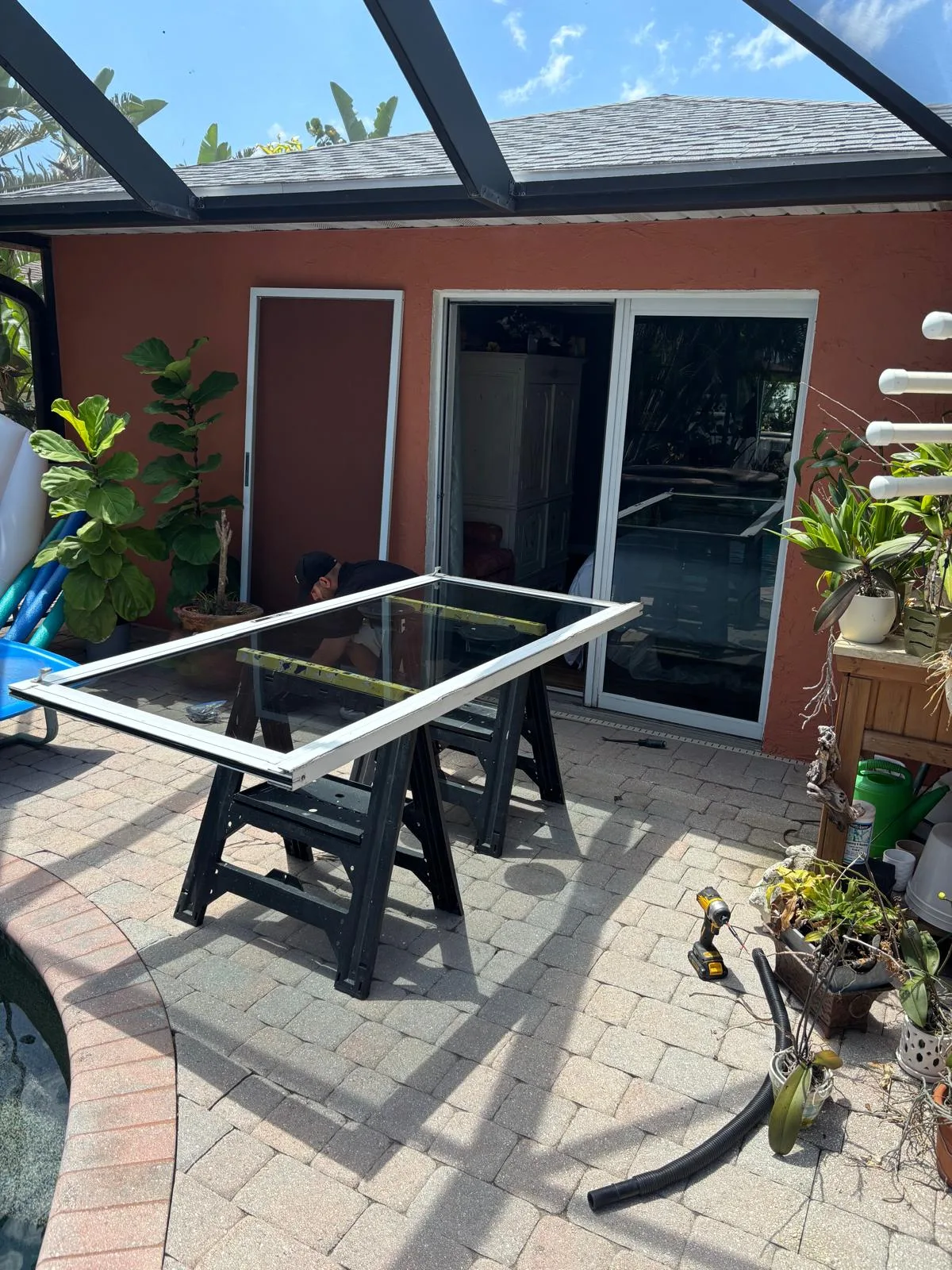
When the 4-step tune-up isn't enough
If silicone and adjustment don't free the panel, the rollers come out for inspection. About half the time the bearings are seized solid; the other half show flat spots from years of being shoved. Either way, fresh rollers and a track polish put the panel back to glide-with-a-fingertip.
When should I call a pro for a hard-to-open door?
Call if you see any of these red flags: the door takes two hands or a foot brace to move, you can hear metal grinding on every cycle, the wheels are visibly flat-spotted or cracked, the panel is visibly tilted in the frame, the door is too heavy to lift safely for roller swap (3/4-inch impact glass panels run 200+ lb), or the 4-step DIY didn't hold for more than a week. Roller replacement requires pulling the panel completely off, swapping the wheel assemblies, and dialing the height back in - always a two-person job at minimum. We carry Andersen, PGT, CGI, Pella, Milgard, and JELD-WEN roller assemblies on the truck for same-day matching across Stuart, PSL, Jensen Beach, Fort Pierce, Vero Beach, and Palm City.
How much does it cost to fix a hard-to-open sliding door?
Treasure Coast 2026 pricing: a pro tune-up (deep-clean, silicone, roller height adjust, weatherstrip check) is $99-$199 - the cheapest call and the one most likely to solve a recently-dragging door. Roller replacement runs $149-$299 per panel and includes pulling the door, swapping wheel assemblies, re-installing, and height-screw calibration. Track repair (straightening a dented rail, patching corrosion pits, replacing track caps) is $129-$349. Jamb shim or jamb-plane for swollen-wood drag is $129-$249. Combined rollers + track on one door runs $300-$650. Always a written quote before work starts, no diagnostic fee, no surprises.
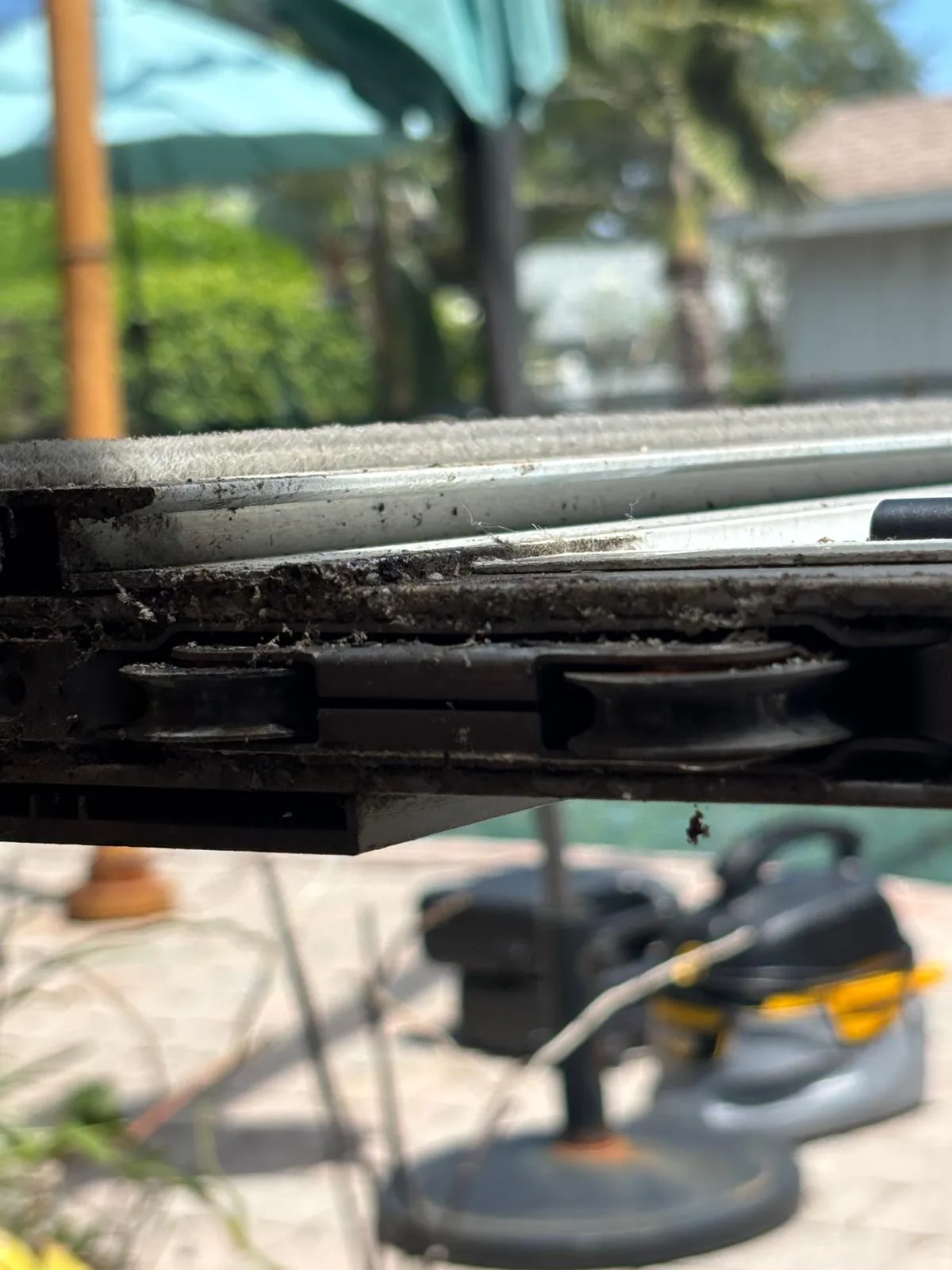
What seized rollers look like
The cages are pitted from salt aerosol and the bearings won't turn at all. The homeowner had been shoving the door for six months - the wheel housings ate a groove into the aluminum track in the process.
How long does the repair take?
A simple tune-up is 20-30 minutes from arrival. Roller replacement is 45-60 minutes per single panel, 90 minutes for a double-panel slider. Track repair varies - straightening or patching is 60-90 minutes; full track replacement is 2-3 hours and the door stays out of the rail during that window (plan for a tarp or board if you need to secure the opening overnight). Jamb shim or plane work is 30-45 minutes plus paint-touch dry time. Same-day service is the standard across all 6 GBP cities. After-hours and emergency calls available 24/7 - storm-season volume can stretch response to next-morning, but we tell you up front if that's the case.
Can Florida salt air or hurricanes cause a hard-to-open door?
Yes, and the two effects compound each other on the Treasure Coast. Salt air corrodes roller bearings 2-3x faster than inland averages - a roller cage that would last 12 years in Ocala lasts 5-8 years on the barrier islands. Coastal homes within 2 miles of the Atlantic or Indian River Lagoon also see aluminum track pitting, which creates micro-roughness that the wheels have to climb over on every cycle. Hurricane shock loads from Ian, Nicole, and the 2025 season rack frames enough that previously-fine doors no longer fit their original jambs - the panel rubs the lead jamb on every open. Florida Building Code 8th Edition impact-rated panels (PGT WinGuard, CGI Sentinel, Andersen Architectural) are 40-80 lb heavier than 1990s aluminum doors, which puts more load on rollers and accelerates wear. If your door went from smooth to hard-to-open right after a storm, document with photos and check your insurance coverage before paying out of pocket.
How do I prevent my door from getting hard to open again?
A five-minute monthly routine prevents about 80% of hard-to-open complaints. Vacuum the bottom track once a month, every two weeks if you have pets or live on a barrier island. Spray silicone-based lubricant along both rails every 3-4 months. Check roller height adjustment screws twice a year, before and after hurricane season. Wipe down weatherstripping with mild soap once a year so it doesn't shed grit into the track. Reseal pitted aluminum track sections with marine-grade silicone if you're within 2 miles of salt water. Inspect the wood jamb in August - if you can see the panel rubbing the lead stile, a tiny jamb-plane now beats a swollen-panel emergency in September. With this routine, rollers typically last 10-15 years even on coastal homes. See our full maintenance routine for the step-by-step.
Will homeowner's insurance cover a hard-to-open door?
It depends on the cause. Wear and tear (rollers worn out from 12 years of normal use, debris-compacted track) is NOT covered under any standard policy - that's classic maintenance, on the homeowner. Storm damage that racked the frame (hurricane, named storm, flying debris) is almost always covered under the dwelling section of your policy - file within the policy claim window (usually 1 year, check your specific carrier). Sudden accidental damage (someone slammed the door against the jamb, a heavy object struck the panel) may be covered under personal liability. Mold or water intrusion damage secondary to a frame-shift issue often qualifies under an original storm claim if filed promptly. Document everything with photos, get a written diagnosis from a licensed door technician, and submit before the claim window closes. We provide insurance-ready written estimates on every Treasure Coast call at no extra charge.
Hard-to-open sliding door questions we hear in Treasure Coast homes.
Why did my sliding door suddenly get hard to open?
Is silicone spray or graphite better for sliding door tracks?
Can a swollen door frame make a sliding door hard to open?
How heavy is a typical sliding glass door panel?
Will my home warranty cover a hard-to-open sliding door?
How long should new rollers last in a Vero Beach home?
Related articles.
Treasure Coast cities we serve
All 10 Treasure Coast cities. Mobile service, fast quote, no nonsense.