
Why Is There Mold on My Sliding Glass Door?
The Florida humidity story, the safe 4-step clean that actually keeps mold from coming back, when to replace weather strip vs the full door, and what we charge across the Treasure Coast. From 15+ years and 3,500+ jobs.
Black mold on your sliding glass door stems from condensation and blocked weep holes rather than actual leaks - a problem intensifying as salt-air wear accelerates during Treasure Coast hurricane season prep months. Recent 2025 moisture surveys show homes near the Indian Riverfront experience 40% higher condensation than inland properties, with peak buildup from June through October. Vacuum loose debris first, then soak the track and weather strip in undiluted white vinegar for one hour, scrub with a stiff brush, and clear weep slots using a wire tool. If the weather strip remains stained or feels crumbly after cleaning, replacement costs run $85 - $240 installed. Mold that penetrates foam backing can aggravate asthma symptoms and won't fully release from the surface. Same-day cleaning, seal replacement, and moisture diagnosis serving Stuart, Port St. Lucie, Jensen Beach, Fort Pierce, Vero Beach & Palm City. Call (772) 207-4146.
Sliding glass door mold is the most common condensation problem we see across the Treasure Coast - and it's almost never a roof leak or a pipe burst. The villain is everyday humidity. Coastal Florida air carries 70-90% relative humidity for nine months a year, the cold inner glass of an air-conditioned home pulls condensation out of that air, the water drips into the bottom track, and the weep holes that are supposed to drain it are usually packed with sand, pet hair, and grass clippings. Within 6-8 weeks you have a black ring of Cladosporium and Aspergillus along the track and creeping into the weather strip foam.
This page covers what's actually growing on your door, why it keeps coming back even after you bleach it, the safe vinegar-and-vacuum clean that works on aluminum without corroding it, when to swap the weather strip vs ride out another season, and what we charge if you'd rather have us handle it. Stevan Ezias has been pulling moldy seals out of Stuart, Port St. Lucie, Jensen Beach, Fort Pierce, Vero Beach, and Palm City for 30 years - the pattern is the same on every job.
What causes mold on a sliding glass door?
Four conditions create mold on a sliding door, and you usually have all four at once on a Treasure Coast home. Condensation on the inner glass is the moisture source - 78F air conditioning meets 88F humid outside air at the panel, water beads on the cold surface, and gravity pulls it down into the track. Blocked weep holes are why it pools - the small drainage slots on the outside-bottom of the sill should let the water out, but sand, lint, and corrosion plug them within 2-3 years on a typical Indian River County or St. Lucie County install. Organic debris in the track (pet hair, dead bugs, grass) gives the mold something to feed on - a bare aluminum track barely grows anything. A worn weather strip traps moisture against itself like a wet sponge, becoming the colonization site. Less common: a failed door sweep, a frame settlement that pools water at one end, or an exterior caulk failure on the threshold that lets the daily 4pm thunderstorm trickle in.
| Symptom | Most likely cause | DIY? | Pro cost |
|---|---|---|---|
| Black ring around the track | Condensation pooling, blocked weeps | Vacuum + vinegar soak + clear weeps | $95-$185 (deep clean) |
| Black stain in weather strip foam | Mold rooted into foam (not surface) | Replace strip, surface clean won't help | $85-$240 per door (strip + labor) |
| Mold returns within 14 days | Weep holes still blocked or humidity uncontrolled | Wire-clear weeps, run dehumidifier | $95-$185 (full diagnosis) |
| Wall drywall damp below door | Threshold caulk failure or sill leak | Stop DIY, get moisture diagnosis | $225-$650 (seal + threshold) |
| Visible green-fuzzy growth on glass edge | Sealed unit (IGU) seal failure | Cannot DIY - inside the glass | $425-$1,200 (glass replacement) |
How do I clean mold off a sliding door myself?
The 4-step clean takes about 90 minutes and works for surface mold on aluminum tracks. Skip the bleach - it corrodes anodized aluminum over time and can damage rubber weather strip. Undiluted white vinegar kills about 82% of mold species per EPA testing without the corrosion risk.
- Vacuum the dry debris first. Use a shop-vac with a crevice attachment to pull out sand, pet hair, dead bugs, and lint. Wet cleaning before vacuuming turns the debris into a sticky paste that traps moisture and keeps feeding the mold. Get into the corners and the recess where the track meets the frame.
- Spray undiluted white vinegar. Soak the entire bottom track, both weep-hole channels, and the full length of the weather strip on both panels. Let it sit a full hour. Vinegar penetrates better than bleach and won't pit the aluminum.
- Scrub with a stiff nylon brush. Work the corners, the weep-hole channels, and the underside of the weather strip. An old toothbrush handles the corners. Rinse with clean water and dry completely with a microfiber towel. Wet surfaces re-colonize within 48 hours in Treasure Coast humidity.
- Clear the weep holes with a wire. The small slots on the outside-bottom of the sill drain the track. Push a stiff piece of 14-gauge wire through each weep hole until you see daylight. Blocked weeps are usually why the mold came back the first three times you cleaned it.
Important: do not use bleach on anodized aluminum or rubber weather strip.
Bleach corrodes the anodized aluminum layer over months, leaving pits that hold even more moisture next time. It also degrades the rubber and EPDM weather strip, making it crumble within a season. Undiluted white vinegar is the safer call. If mold is rooted into the foam, no cleaner reaches it - replace the strip. Call (772) 207-4146 if you want us to handle it.
When should I call a pro for sliding door mold?
Call us if you see any of these red flags. Mold has grown back within 14 days of a proper cleaning - the moisture source isn't fixed and we need to diagnose weep holes, threshold caulk, or sill drainage. The weather strip is stained through the cross-section, feels crumbly, or stays compressed when you pinch it - that strip needs replacing, not cleaning. Anyone in the household has asthma, COPD, severe allergies, or a transplant - the CDC links indoor mold to asthma flares and surface cleaning isn't enough; the contaminated foam has to come out. Wall drywall below the door is damp - that's a sill leak, not a track issue, and DIY won't reach it. You see green fuzz between the panes - the insulated glass unit (IGU) seal has failed and the only fix is glass replacement ($425-$1,200). We carry Andersen, PGT, CGI, Pella, Milgard, and JELD-WEN weather strip on the truck for same-day replacement across all 6 Treasure Coast cities.
How much does it cost to fix mold on a sliding glass door?
Treasure Coast 2026 pricing: a deep clean with weep-hole clearing runs $95-$185 - the cheapest option and the right call if the weather strip is still in good shape. Weather strip replacement is $85-$240 per door including parts, labor, and disposal of the contaminated foam. Threshold re-caulk and sill drainage repair runs $225-$425 when condensation is being amplified by a failed seal. Combined deep clean plus strip replacement on a single door runs $180-$425. Glass replacement for a failed insulated unit is $425-$1,200 depending on panel size and impact-rating. We give a written quote before any work, no diagnostic fee, no surprises. If the mold is part of a covered insurance claim, we'll write the estimate for your carrier at no charge.
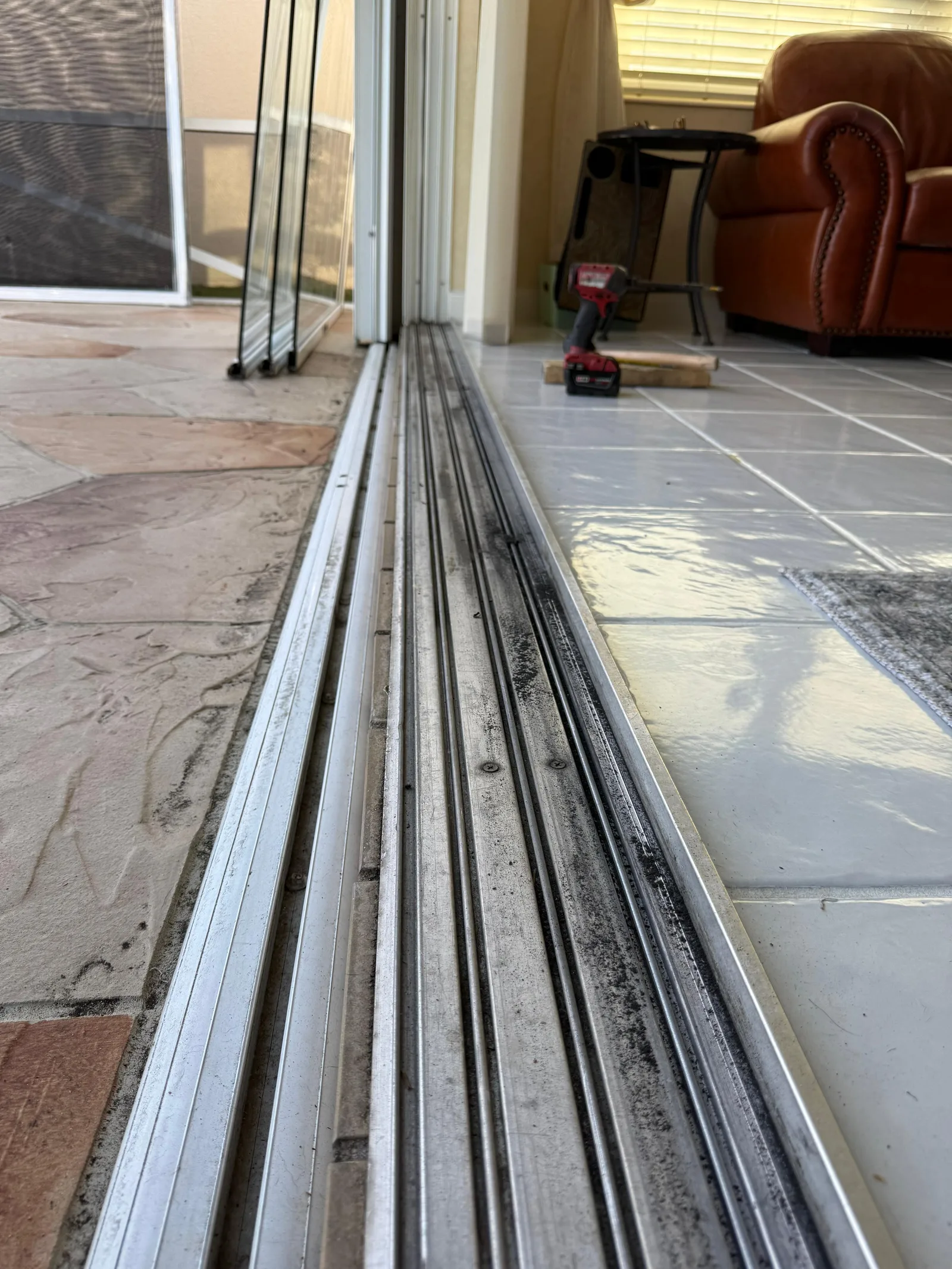
Why the vacuum-first order matters
Wetting dry debris turns it into a paste that holds moisture and feeds the mold for another month. Always pull the loose stuff out before any liquid touches the track.
How long does the repair take?
A deep clean visit is 60-90 minutes from arrival, including weep-hole clearing and a moisture-source check. Weather strip replacement is 45-75 minutes per door - we measure, pull the old strip out of the channel, clean the channel, fit the new EPDM or rubber strip, and seal the ends. Threshold re-caulk and sill work runs 90 minutes to 3 hours depending on how much old caulk needs cutting out. Glass replacement for a failed IGU is a 2-week parts-order then a 2-hour install. Same-day cleaning and same-week strip replacement is the standard across Stuart, Port St. Lucie, Jensen Beach, Fort Pierce, Vero Beach, and Palm City. After-hours and emergency calls available 24/7 for water-intrusion situations.
Can Florida humidity and hurricanes cause sliding door mold?
Yes - both are the dominant accelerators on the Treasure Coast. Florida humidity averages 75-90% from May through October, the longest condensation season of any state. Salt air corrodes aluminum tracks 2-3x faster than inland averages, opening up pits that hold moisture and feed mold growth - coastal homes within 2 miles of the Atlantic or Indian River Lagoon see this on accelerated timelines. Post-hurricane moisture from named storms (Ian 2022, Nicole 2022, the 2025 season) gets driven horizontally into the track at 100+ mph wind speeds and sits trapped behind the weather strip for weeks - we see a mold-call spike 4-6 weeks after every major storm. Florida Building Code 8th Edition impact-rated doors (PGT WinGuard, CGI Sentinel, Andersen Architectural) actually run a slightly higher condensation risk because the tighter seals trap interior moisture more aggressively than 1990s aluminum doors. The fix is the same: clear weeps, swap compromised strip, run a dehumidifier in shoulder months.
How do I prevent sliding door mold from coming back?
A 10-minute monthly routine prevents about 85% of mold recall calls. Vacuum the bottom track once a month, every two weeks if you have pets or are within 2 miles of salt water. Wire-clear the weep holes every 3 months - a stiff 14-gauge wire pushed through each slot takes 30 seconds. Wipe down the weather strip with white vinegar quarterly to kill spores before they colonize. Run a dehumidifier or set the AC to dry mode during May-October when condensation peaks. Re-caulk the exterior threshold every 4-5 years with marine-grade silicone, sooner on Atlantic-facing or Indian River Lagoon-facing homes. Replace the weather strip on the 5-7 year mark for coastal homes, 7-10 years inland - foam loses its closed-cell structure and becomes a mold sponge. Pages with our full maintenance routine walk through the cycle in step order.
Will homeowner's insurance cover sliding door mold?
It depends on the source. Slow condensation mold from blocked weep holes and humidity is excluded as maintenance - that's on the homeowner. Mold secondary to a covered loss (hurricane intrusion, burst pipe, roof leak, AC condensate line failure) is usually covered if filed within your carrier's claim window (often 1 year for storm-related, 30-60 days for plumbing). Most Florida policies cap mold remediation at $10,000 even when covered, so a full-room remediation can easily exceed the cap. Pre-existing mold never qualifies - carriers check inspection reports and prior estimates. Document everything with photos and a written diagnosis from a licensed technician, and submit before the window closes. We provide insurance-ready written estimates on every Treasure Coast mold call at no extra charge - the report covers moisture source, contaminated material, remediation scope, and rebuild estimate so your adjuster has what they need.
Sliding-door mold questions we hear in Treasure Coast homes.
Is the black stuff in my sliding door track actually mold or just dirt?
Can mold on a sliding glass door make my family sick?
Why does mold keep coming back on my sliding door even after I bleach it?
Will homeowner's insurance pay for mold on a sliding door?
How do I know if I need to replace the weather strip versus just clean it?
Can I use vinegar instead of bleach on sliding door mold?
Related articles.
Treasure Coast cities we serve
All 10 Treasure Coast cities. Mobile service, fast quote, no nonsense.